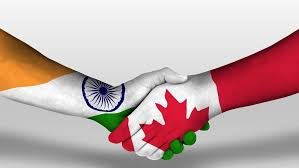
Ottawa, Canada — In what is being hailed as a historic watershed moment for Indo-Canadian relations, the largest-ever business and trade delegation from India has landed in Canada. Led by Indian Minister of Commerce and Industry Piyush Goyal, the delegation includes more than 100 senior corporate executives, startup founders, and industry leaders spanning the mining, clean energy, automotive, aerospace, and technology sectors.
The high-stakes, three-day summit—running from Monday to Wednesday—marks a dramatic and rapid transformation in bilateral relations. Only a few years ago, ties between Ottawa and New Delhi were frozen in a severe diplomatic standoff. Today, the atmosphere is defined by mutual economic necessity, aggressive diversification strategies, and an ambitious goal: doubling two-way trade to $70 billion by 2030.
A Dramatic Diplomatic Reset
The arrival of this massive delegation would have been unthinkable just three years ago. In 2023, Indo-Canadian relations hit a historic nadir when Canada’s previous administration publicly accused the Indian government of involvement in the assassination of a Canadian Sikh activist in British Columbia. The fallout was immediate and severe: diplomatic staff were expelled, visa services were temporarily suspended, and long-standing trade negotiations ground to a sudden halt.
The turning point came with a change in Canada’s political leadership. Following his accession to office in 2025, Prime Minister Mark Carney made resetting relations with New Delhi a central foreign policy priority. Recognizing India’s indispensable role in global economics and the Indo-Pacific region, Carney sought to separate complicated geopolitical frictions from mutual economic opportunities.
The thawing of Indo-Canadian relations culminated in March 2026, when Carney travelled to Mumbai and New Delhi to meet with Indian Prime Minister Narendra Modi. That landmark visit concluded with more than $5.5 billion in commercial agreements, including a crucial $2.6-billion strategic partnership to supply 22 million pounds of Canadian uranium to power India’s expanding civil nuclear energy grid.
“This is not merely the renewal of a relationship,” Carney remarked at the time. “It is the expansion of a valued partnership with new ambition, focus, and foresight.”
Fast-Tracking the Free Trade Pact
The primary institutional objective of Minister Goyal’s visit is to inject momentum into the negotiations for a Comprehensive Economic Partnership Agreement (CEPA). While official talks have technically dragged on since 2010, negotiators from both sides are now working under a tight timeline to finalize a comprehensive free trade deal by the end of 2026.
Minister Goyal opened the summit on Monday morning in Ottawa with his Canadian counterpart, International Trade Minister Maninder Sidhu. According to statements released by both ministries, the two nations are actively fast-tracking negotiations that encompass goods, services, digital trade, agricultural market access, and professional mobility.
CURRENT VS. TARGET BILATERAL TRADE
2026 Estimate: ~ $13-15 Billion (Goods & Services)
=============================================================
2030 Target: $70 Billion
=============================================================================
For Canada, cementing a trade pact with India is a critical piece of its broader “China-plus-one” strategy. As geopolitical tensions and tariff anxieties make reliance on Chinese supply chains increasingly risky, Canadian businesses are desperate to secure alternative footholds in Asia. India, with its rapidly growing middle class and a massive consumer market of 1.4 billion people, represents the ultimate diversification prize.
Complementary Economic Needs
The sheer diversity of the visiting delegation underscores just how neatly the economic needs of the two nations align. India is undergoing an unprecedented infrastructure and industrial boom, requiring massive amounts of raw materials, energy, and capital—all of which Canada possesses in abundance.
Energy Security and the Green Transition
With India committed to rapidly expanding its economy while simultaneously hitting carbon-reduction targets, energy cooperation has taken center stage. Beyond the massive uranium deal signed in March, the delegation is actively exploring partnerships in clean technology, hydrogen development, and carbon capture.
Critical Minerals and Manufacturing
India’s automotive and aerospace executives are in Canada with a very specific shopping list: critical minerals. Canada’s vast, unexploited reserves of lithium, nickel, cobalt, and copper are vital for India’s ambitious push into electric vehicle (EV) manufacturing and domestic electronics production. Representatives from the mining and automotive sectors are utilizing the summit to negotiate direct supply agreements and joint ventures.
Institutional Capital and Investment
On the flip side, India is seeking a steady influx of reliable foreign capital. The country has recently experienced significant foreign investment outflows and a weakening rupee, making Canadian institutional investors incredibly attractive partners. Minister Goyal is scheduled to hold private roundtables with the CEOs of Canada’s largest pension funds and asset managers. Canadian pension funds have already proven to be marquee investors in Indian infrastructure, and New Delhi hopes to secure billions more for toll roads, green energy grids, and digital infrastructure.
| Sector | Primary Indian Objective | Primary Canadian Objective |
| Energy & Mining | Secure uranium and critical minerals (lithium, nickel) for EV manufacturing. | Export raw materials and green technologies to a massive growth market.
| Finance & Capital | Attract Canadian pension funds to stabilize foreign investment inflows. | Secure high-yield, long-term infrastructure assets in a growing economy. |
| Tech & Startups | Expand IT services and foster cross-border venture capital pipelines. | Access high-skilled technical talent and digital trade collaboration. |
Overcoming Corporate Friction
While political enthusiasm for a deal is at an all-time high, the corporate representatives on the ground are tasked with solving practical, real-world trade barriers.
Indo-Canadian business groups have historically voiced frustrations regarding India’s complex domestic regulatory environment. Small- and medium-sized Canadian enterprises frequently cite a lack of regulatory transparency, sudden shifts in domestic tax policies, and bureaucratic red tape as major deterrents to entering the Indian market. Representatives at the summit are pressing for streamlined administrative processes and clearer legal protections for foreign corporations embedded in the CEPA framework.
Conversely, the Indian delegation is highly focused on “mobility”—ensuring that Indian tech workers, engineers, and corporate executives can easily obtain visas to manage operations and deliver services within Canada. With education-related travel and professional services already comprising a massive chunk of Canada’s multi-billion-dollar service exports to India, smoothing out immigration and temporary work pathways remains a top priority for New Delhi.
Looking Ahead
The summit will continue through mid-week, moving from formal ministerial sessions in Ottawa to high-level networking events and corporate match-making sessions in Toronto, organized in partnership with the Indo-Canadian Chamber of Commerce (ICCC). Minister Goyal is also expected to sit down for a private working dinner with Prime Minister Carney and Foreign Affairs Minister Anita Anand to review the progress of the trade framework.
While significant technical hurdles remain before a final free trade agreement can be signed, the arrival of this unprecedented delegation sends a clear signal to global markets: Canada and India have officially moved past their grievances. Driven by matching economic puzzles and a mutual desire to reshape global supply chains, both nations are moving aggressively to build what Carney described as a Indo-Canadian partnership of “ambition, focus, and foresight.”
