Home Community Securing the Canadian Table: The National Food Security Strategy

Securing the Canadian Table: The National Food Security Strategy

0


In early 2026, the Canadian government reached a critical legislative and economic juncture. Facing persistent global supply chain shocks, domestic inflationary pressures, and escalating geopolitical trade friction, Prime Minister Mark Carney’s administration introduced a sweeping legislative framework designed to fundamentally restructure how Canada secures, distributes, and prices its food supply. Anchored by the passage of Bill C-19—the Canada Groceries and Essentials Benefit Act—the administration’s National Food Security (NFS) Strategy represents a multi-layered policy shifting away from temporary economic band-aids toward long-term, structural food autonomy.
With food bank usage hitting an unprecedented 2.2 million visits per month and nearly one in four Canadian households identifying as food insecure, the Carney government’s policy acts as both an immediate financial lifeline and a macro-focused blueprint for sovereign supply chains.

The Dual-Track Framework: Immediate Relief and Structural Reform

The architecture of the strategy relies on a distinct dual-track framework. Recognizing that structural changes in agricultural supply chains take years to mature, the administration paired its long-term policy goals with immediate, aggressive cash transfers to insulate lower- and modest-income households from soaring supermarket costs.
┌────────────────────────────────────────────────────────┐
│ Mark Carney’s National Food Security Strategy │
└───────────────────────────┬────────────────────────────┘
                            │
            ┌───────────────┴───────────────┐
            ▼ ▼
┌───────────────────────┐ ┌───────────────────────┐
│ Immediate Relief │ │ Structural Reform │
│ (Demand-Side Support) │ │ (Supply-Side Autonomy)│
└───────────┬───────────┘ └───────────┬───────────┘
            │ │
            ├─► Canada Groceries & ├─► Greenhouses & Abattoirs
            │ Essentials Benefit │ Capital Deductions
            │ │
            └─► Permanent National └─► Supply Chain Resilience
                School Food Program & Competition Oversight
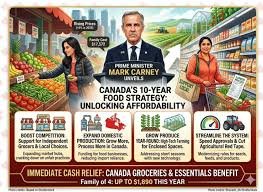
On the demand side, the signature initiative is the Canada Groceries and Essentials Benefit (CGEB), an evolution and enrichment of the traditional Goods and Services Tax (GST) credit. The benefit delivers immediate assistance through a dual-mechanism approach:
 The Spring Top-Up: An immediate 50% cash injection based on the annual 2025–2026 GST credit value, injecting $3.1 billion directly into the pockets of more than 12 million Canadians.
 The Five-Year Enrichment: A sustained 25% increase to regular quarterly payments extending out for five years, representing an $8.6 billion commitment to lower-income households.
For a family of four with a net income of $40,000, this structural change amounts to $1,890 in total benefits for the 2026–2027 benefit year. This immediate intervention provides a critical financial runway while the supply-side reforms of the broader NFS strategy take root.

Supply-Side Autonomy and Agricultural Infrastructure

The true policy shift of the Carney strategy, however, lies in its supply-side economics. Speaking at the World Economic Forum in Davos, Prime Minister Carney noted that “a country that cannot feed itself has few options.” This perspective forms the basis of the strategy’s goal to strengthen domestic food production and decouple the Canadian food supply from hyper-vulnerable global logistics networks.
To address the reality that Canada relies heavily on foreign inputs—ranging from specialized farm machinery to phosphorus imports—the strategy introduces robust capital incentives for domestic food producers. Chief among these is a new provision that allows agricultural producers to immediately deduct the full cost of new greenhouses and food-processing infrastructure.
By granting immediate tax write-offs, the government aims to catalyze private capital into year-round domestic cultivation, expanding Canadian greenhouse networks and micro-processing abattoirs closer to consumer hubs. Supported by $150 million through the Regional Tariff Response Initiative, these measures seek to eliminate the logistical middlemen and tariff exposures that consistently drive shelf prices higher.

Combating Corporate Concentration and “Shrinkflation”

A national food security strategy cannot succeed if market dynamics permit excessive corporate consolidation to dilute supply gains. The NFS strategy explicitly targets retail-level vulnerabilities by expanding the enforcement mandates of the Competition Bureau.
Under the new directive, the bureau receives direct funding and policy support to monitor, investigate, and enforce strict anti-competitive rules across the major grocery conglomerates and agricultural supply networks. The goal is clear: prevent corporate gouging and ensure that input cost savings achieved through domestic infrastructure investments are actually passed down to consumers.
Furthermore, the strategy mandates the implementation of standardized unit price labelling across Canadian grocery retail locations. This specific retail reform directly targets the hidden inflation of “shrinkflation“—where manufacturers reduce product volumes while maintaining identical packaging and price tags. Standardized unit pricing forces transparent price-per-weight comparisons, handing financial clarity back to the consumer at the point of sale.

Regional Disparities and Northern Sovereignty

A critical test of any Canadian social strategy is its capacity to address regional wealth gaps, particularly in remote and indigenous communities. Food insecurity manifests most severely in the Canadian North, where logistical isolation routinely drives the cost of fresh, nutritious food to multiples of the national average.
┌───────────────────────────────────────────────────────────────────┐
│ Northern & Vulnerable Infrastructure Focus │
├──────────────────────────────────┬────────────────────────────────┤
│ Target Demographic │ Policy Mechanism │
├──────────────────────────────────┼────────────────────────────────┤
│ Remote & Indigenous Communities │ Targeted Northern Food Security│
│ │ System & Harvesting Support │
├──────────────────────────────────┼────────────────────────────────┤
│ High-Vulnerability Households │ Permanent National School │
│ │ Food Program (400,000 children)│
├──────────────────────────────────┼────────────────────────────────┤
│ Crisis & Emergency Access │ $20 Million Top-Up to the │
│ │ Local Food Infrastructure Fund │
└──────────────────────────────────┴─────────────────────────────
The NFS strategy answers this challenge by introducing distinct, localized supply interventions specifically designed for northern food systems. Rather than relying entirely on heavily subsidized transport lines, the policy directs funding toward community-led food infrastructure, cold-storage facilities, and local harvesting programs.
Concurrently, to ease the extreme pressure exerted on civil society safety nets, the administration announced a $20 million top-up to the Local Food Infrastructure Fund, providing regional food networks and community kitchens with immediate resources to deliver fresh, non-perishable staples to vulnerable populations.

The Intersection of Canadian Food Security and National Defence

A growing consensus among geopolitical analysts and macroeconomists suggests that the Carney administration’s food strategy must eventually go further by integrating directly into Canada’s core defence architecture. Critics and policy advocates note that while the government’s Defence Investment Strategy (DIS) identifies critical sovereign capabilities, agricultural stability and input independence have historically been left on the periphery.
True food security requires addressing upstream vulnerabilities. Currently, Canada’s agrifood sector remains deeply reliant on foreign partners for essential inputs:
 Antibiotics & Crop Protection: Over 80% of active antibiotic ingredients required for livestock management originate from overseas suppliers like China and India, while essential pesticides remain dominated by international manufacturing conglomerates.
 Fertilizer Dynamics: Despite Canada’s massive global advantage in potash and nitrogen production, domestic agricultural production remains exposed to overseas volatility for phosphorus components.
 Cyber Resilience: As modern processing facilities, dairy networks, and supply logistics digitize, they become prime targets for highly coordinated ransomware attacks.
By actively treating food production as a vital pillar of national security, the NFS framework lays the groundwork for protecting agricultural cyber-infrastructure and securing critical inputs against future geopolitical blockades.

Conclusion: A Long-Term Policy Transition

Prime Minister Mark Carney’s National Food Security Strategy represents a definitive shift in how Canada approaches the intersection of social welfare, agricultural productivity, and sovereign economic policy. By leveraging targeted demand-side assistance through the Canada Groceries and Essentials Benefit alongside aggressive supply-side tax write-offs for greenhouse infrastructure, the policy seeks to build an economy less reliant on erratic international supply chains.
While the program faces real long-term challenges—ranging from severe rural labour shortages to the ongoing threat of cyber-attacks on automated food grids—it establishes a foundational blueprint. The success of the strategy will ultimately be judged by whether it moves Canada beyond cyclical inflationary relief and truly anchors food security as an unassailable asset of national sovereignty.
For a broader perspective on the Prime Minister’s news conference outlining these economic changes and international trade dynamics, you can visit Allymonews for PM Mark Carney Economic Measures Update, which provides context on the domestic rollout and Canada’s wider economic position.

NO COMMENTS

LEAVE A REPLY

Please enter your comment!
Please enter your name here

Exit mobile version