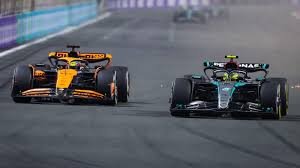
The trajectory of F1 since 2021 has been defined by a fascinating role reversal between the “Works” titan and its most ambitious “Customer.” The rivalry between Mercedes-AMG and McLaren Racing is a case study in aerodynamic philosophy, organizational restructuring, and the relentless pursuit of development velocity. What began in 2021 as a master-and-apprentice relationship has evolved into a dead-heat sprint for supremacy in the 2026 technical era.
2021–2022: The Divergent Path
In 2021, the hierarchy was clear. Mercedes was the eight-time defending champion, locked in a titanic struggle with Red Bull. McLaren, having just returned to Mercedes power, was a rising force, securing a 1-2 finish at Monza. However, the 2022 F1 season saw the ground-effect revolution fracture this stability.
Mercedes famously pursued the “zeropod” concept, a radical aerodynamic bet that the car’s floor could generate enough downforce to compensate for minimal bodywork. It backfired, miring the W13 in “porpoising” and bouncing issues. Meanwhile, McLaren’s initial 2022 offering, the MCL36, suffered from a different ailment: a lack of aerodynamic load and inconsistent brake cooling.
While Mercedes spent 2022 trying to “fix” a broken concept, McLaren began the quiet work of restructuring its technical department. This period was the “Cold War” of the upgrade race—both teams were failing, but they were learning how to fail differently.
2023: The Turning Point
The 2023 F1 season remains the most significant year in this modern upgrade war. Mercedes arrived at the season opener still clinging to the zero-pod design, only to abandon it by the Monaco Grand Prix. This mid-season pivot was a massive logistical undertaking, essentially forcing the team to design a “B-spec” car under the constraints of the cost cap.
However, McLaren executed the greatest mid-season development leap in F1 history. Starting the year as a backmarker, the Austrian Grand Prix upgrade package transformed the MCL60. By introducing a “downwash” sidepod philosophy—heavily influenced by Red Bull’s design—and a completely redesigned floor, McLaren leapfrogged Mercedes in pure pace. For the first time in the hybrid era, the customer wasn’t just beating the works team; they were showing them the technical way forward.
2024–2025: Convergence and Refinement
Entering the 2024 and 2025 F1 season, the “war” shifted from conceptual overhauls to incremental gains. Mercedes finally stabilized their platform with the W15 and W16, focusing on a more predictable “front end” to give their drivers confidence.
McLaren, however, maintained a higher Development Velocity. Under the leadership of Andrea Stella, Woking became an upgrade factory. Every three to four races, a new floor edge or front wing appeared. This period saw the rise of the “Flex-Wing” controversy. McLaren pushed the limits of aero-elasticity—designing wings that passed FIA static tests but deflected at high speeds to reduce drag. Mercedes, initially critical, was forced to develop their own flexible wing solutions by late 2024 to stay competitive.
By the end of 2025, the gap between the two was negligible. McLaren had the edge in high-speed corners, while Mercedes utilized their superior power unit integration to dominate at power-sensitive tracks like Spa and Monza.
2026: The New Frontier
The 2026 season reset the board with two massive changes: Active Aerodynamics and the New Power Unit Regulations.
The Aero Battle: Active Systems
The 2026 F1 regulations require cars to switch between “Z-mode” (high downforce) and “X-mode” (low drag) on straights. This has turned the upgrade war into a software and actuator race.
Mercedes’ Strategy: They have focused on “Chassis-PU Harmony.” Their active aero is deeply integrated with the engine’s energy deployment. When the wing opens, the MGU-K switches to a specific recovery map to ensure no energy is wasted.
McLaren’s Strategy: McLaren has leaned into their wind tunnel—the most modern in the sport, completed in 2023. Their 2026 upgrades have focused on “Flow Stability” during the transition between aero modes. While other cars become unstable when the wings move, the McLaren remains planted.
The Power Unit Paradox
For the first time since 2014, Mercedes HPP (High Performance Powertrains) faced a genuine threat of being overtaken in the engine department. While Mercedes produces the PU for both teams, the “Works” team has the advantage of designing the chassis and engine in the same room.
McLaren has countered this “Works” advantage by becoming a “Virtual Works Team.” They have embedded engineers at Brixworth to ensure their 2026 chassis packaging is as tight as the Mercedes W17. The current upgrade war isn’t just about the wings you see; it’s about the cooling efficiency you don’t. McLaren’s recent “radiator-shrink” upgrade has allowed for an even narrower coke-bottle shape at the rear, a design feat previously reserved only for factory teams.
Comparison: Development Philosophies (2021–2026)
| Era | Mercedes Focus | McLaren Focus | Outcome |
| 2021-22 | Experimental Concepts (Zeropods) | Recovery & Foundation | Mercedes remained ahead but stalled. |
| 2023-24 | Concept Correction & Stability | High-Frequency Aero Upgrades | McLaren became the benchmark for mid-season gains. |
| 2025-26 | PU Integration & Active Systems | Aero-Elasticity & Efficiency | Parity reached; race-by-race development war. |
The Human Factor: Feedback Loops
An upgrade is only as good as the driver’s ability to use it. The feedback loop between George Russell (Mercedes) and Lando Norris (McLaren) has dictated the direction of these upgrades. Russell has pushed Mercedes toward a car that rewards aggressive trail braking, prompting complex suspension upgrades. Norris and Oscar Piastri have pushed McLaren toward a “neutral” car, leading to the sophisticated floor designs that make the MCL series so formidable in varied conditions.
Conclusion: A Rivalry Without a Ceiling
As we stand in the midst of the 2026 F1 season, the “upgrade war” has reached its most intense phase. We no longer see “B-spec” cars; instead, we see a constant stream of micro-evolutions. A new endplate in Miami, a revised diffuser in Barcelona, a software patch for the active aero in Silverstone.
Mercedes remains the gold standard for structural integrity and engine-chassis synergy. However, McLaren has proven that a modern, agile technical department can overcome the “customer” label through sheer development speed. Since 2021, these two teams have pushed each other from the depths of technical crises to the pinnacle of the sport. In the 2026 era, the winner won’t be the team with the best starting car, but the team that can win the war of the drawing boards between now and the season finale.
